
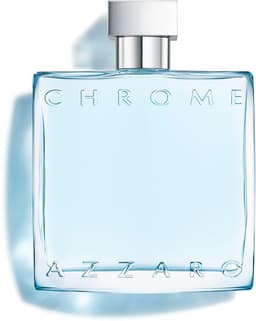
Azzaro launched Chrome in 1996 on a premise of transmission between a father and his son. Gérard Haury signed the formula, a fresh citrus laid over a woody, musky base that has traveled the world. The note lists circulating under this name all contradict each other; some of them actually describe a 2015 flanker: only seven materials withstand cross-checking against two independent sources.
Chrome ranks among the best-selling masculines on the planet and among the most poorly documented. Three note lists circulate under its name, incompatible with one another, and one of them describes a different fragrance than the blue 1996 bottle.
The confusion is not trivial: it decides what a buyer believes they smell. Only materials attested by two independent origins have been retained, and the discarded ones are named along with the reason for their removal.
Three note lists, and one belongs to another fragrance
The most widespread comes from mainstream encyclopedic databases: lemon, rosemary, bergamot, neroli and pineapple in the opening, jasmine, oakmoss, cyclamen and coriander in the middle, musk, cedar, sandalwood, cardamom, rosewood and tonka bean in the base.
The second circulates on French and German retail pages: bergamot, grapefruit, ginger and hedione, an ozonic note, a water jasmine and a lichen, precious woods, yerba mate, amber and musk. It sounds precise.
It describes Azzaro Chrome Intense, released in summer 2015, as Fragrantica published it at launch. Copied from retailer to retailer, it settled onto the 1996 eau de toilette, to which it never belonged.
The third, older one, lists lavender, dihydromyrcenol, violet, green note, tea and evernyl. No public source repeats it and none supports it. Yet it carries Chrome's reputation as the fragrance of the freshness molecule.
The seven materials backed by two independent sources
Bergamot and lemon open the bottle. The house highlights bergamot in its current presentation, encyclopedic databases also list it, and the regulatory list carries limonene and citral, two markers of pressed citrus.
Oakmoss holds the middle. Databases place it in both the heart and the base; the regulatory list names Evernia prunastri extract, which settles the question of its presence without settling that of its tier.
White musks, cedar, yerba mate and tonka bean form the base. The house names transparent musk and mate leaves among the three materials it highlights, and the declared coumarin accompanies the tonka bean.
Seven materials where ten once stood. The heart shrinks to a single one and this gap shows. It is better than a full pyramid half of which comes from a 2015 flanker or from a list no one countersigns.
A freshness Chrome did not invent
Dihydromyrcenol is a product of International Flavors & Fragrances, developed around 1970. Its clean laundry smell earned it a career in detergents, which masculine perfumery interrupted.
Maurice Roucel dates its entry into masculine perfumery to the 1970s, with Azzaro pour Homme. Drakkar Noir reportedly carried ten percent of it in 1982, and Cool Water double that in 1988, signed by Pierre Bourdon.
The very first use is disputed: some sources trace it back to Paco Rabanne Pour Homme in 1973, others make Cool Water the starting point. The disagreement is stated rather than settled.
Chrome appeared in 1996, eight years after Cool Water. English-language criticism casts it as a follower of a wave already launched by Calvin Klein and Davidoff. Its distinctiveness lies in its own floral surge, not in its freshness.
Gérard Haury, one name for a single formula
The composition is credited to Gérard Haury. Professional databases attribute no other creation to him, and the rare mentions link him to Haarmann & Reimer, a German raw-materials house since absorbed by Symrise.
His trace stops there. His son, perfumer Raphaël Haury, born in Grasse and trained at Charabot, is better documented: Chaumet Homme in 2000, and several fragrances for the same house, Azzaro.
Chrome spawned an entire family of flankers — Legend, Sport, United, Intense, Pure, Extrême — signed by other noses, including Olivier Pescheux and Christophe Raynaud. None of them reuses the 1996 formula, and that is where the confusion comes from.