
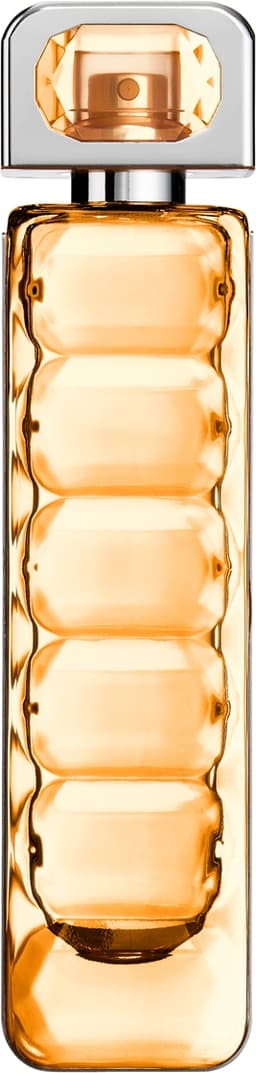
Launched in the summer of 2009, Boss Orange is the first women’s fragrance from Boss Orange, Hugo Boss’s relaxed, bohemian line. Annick Ménardo composed it as an amber woody scent: crisp apple, bergamot, and white peach in the top; orange blossom, plum, and cinnamon in the heart; creamy vanilla, sandalwood, and olive tree wood in the base. Sienna Miller is its face.
The house now classifies Boss Orange among the amber woody fragrances. Wikiparfum files it among the woody scents with an amber nuance, and Osmoz describes it as a soft, comfortable woody oriental with a strongly fruity character.
Top, heart, and base
The house now publishes this pyramid: in the top, a crisp apple, bergamot, and a white peach; in the heart, orange blossom with plum and a cinnamon stick; in the base, a creamy vanilla, sandalwood, and olive tree wood.
The notes are arranged here as follows: apple, bergamot, and peach in the top; orange blossom, plum, and cinnamon in the heart; vanilla, sandalwood, and olive tree in the base. The patchouli and violet once attributed to it are missing from every description by the house.
A shorter version
Hugo Boss also circulates a shorter summary: a red apple in the top, orange blossom from Africa and white flowers in the heart, a base of olive tree, sandalwood, and vanilla. Lacking a precise name, the white flowers stay out of the classification.
The notes at launch
In 2009, Procter & Gamble described a generous apple set against jasmine and orange blossom for honeyed accents, a juicy plum, and a velvety white peach. Osmoz places jasmine in the heart, alongside plum and orange blossom, and moves cinnamon to the base.
What the label declares
The ingredient list opens with alcohol, water, and fragrance. Two UV filters, diethylamino hydroxybenzoyl hexyl benzoate and ethylhexyl methoxycinnamate, shield the juice from light; BHT, an antioxidant, slows its deterioration.
Nine allergens subject to declaration appear, from citronellol to benzyl benzoate. Among them, cinnamal, the aldehyde responsible for the smell of cinnamon, echoes the cinnamon stick announced in the heart. Six colorants close the list: two yellows, two reds, one blue, and one violet.
The list contains neither lilial nor lyral. A few perfumeries still display an earlier version, with propylene glycol, a preservative, methylparaben, and only three colorants.
Similar perfumes
Similar notes and family, from other houses.
- Un Jardin à Cythère Eau de ToiletteHermès
- Organza IndécenceGivenchy
- Un Jardin à Cythère Huile SècheHermès
- Ambre Imperial Collection ExtraordinaireVan Cleef & Arpels
- This is Her ! No RulesZadig & Voltaire
- 9pmAfnan
- Repetto Eau de ParfumRepetto
- Vanilla BurnAleka
More perfumes from Hugo Boss
Also composed by Annick Menardo
- Hypnotic PoisonChristian Dior
- Overture 41Amouage
- HypnôseLancôme
- Hypnotic Poison Roller-PearlChristian Dior