
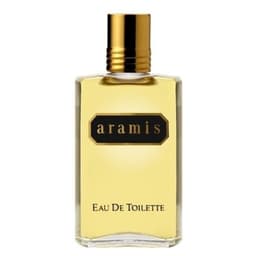
Launched in 1966, Aramis is the leathery chypre that brought prestige men's fragrance into department stores. Bernard Chant reworked the skeleton of his Cabochard here and hardened it: sharp aldehydes, bitter mugwort, then a massive leather propped against oakmoss and patchouli. A frontal classic, one that never learned to apologize.
A chypre, strictly speaking, rests on a contrast: a citrus note at the top, a moss and a labdanum at the base, and nothing in between to soften the passage. Aramis respects this specification and immediately complicates it. Bergamot appears without ever being sun-kissed, and the base of moss and patchouli, which should stay in the background, occupies half the formula. This is a chypre unbalanced from below, and that imbalance is its whole signature.
The initial accord belongs not to the citrus register but to bitter aromatic territory. Mugwort, thyme and sage form a triad evoking dry scrubland rather than a garden, with a vegetal bitterness that grates a little if one brings the wrist too close. Clover adds an inflection of cut stem, more humid, and this is roughly the only place in the formula where anything resembles freshness.
Two materials keep this whole from remaining a mere herbal water. First the aldehydes, whose use in men's perfumery was still rare in the mid-1960s: they bring a waxy, almost soapy brilliance that gives the opening its clean, washed character. Then gardenia, indolic and creamy, which slips a white thickness beneath the aromatics. One pulls upward, the other weighs down from below.
The leather here is not a raw material but an accord, built around isobutylquinoline — a molecule that smells of tar, soot and crushed violet leaf. It is this that produces the dry, almost medicinal leather, far removed from the supple, honeyed leathers composed today. Chant had already used it seven years earlier; he raised its proportion here and stripped away the floral surround that had softened it.
Beneath the leather, four materials work in concert. Oakmoss brings the humus and the earthy bitterness that define the genre. Patchouli, dosed without restraint, gives depth and a camphoraceous edge. Vetiver adds its dry smoke, sandalwood a milky sweetness that only becomes apparent after several hours. Together, they form the framework that justifies classifying this as a woody chypre rather than a chypre alone.
Three materials remain that are never spotted in isolation. Amber warms without sweetening. Musk, frankly animalic, extends the trail far beyond what the formula would lead one to expect. And coconut, present in minimal quantity, acts as a softener: it smooths the leather's edges without ever announcing itself as a gourmand note. The technique was a habit of Chant's, and it is part of what makes the formula difficult to reconstruct — oakmoss, moreover, being far more regulated now than it was then.