
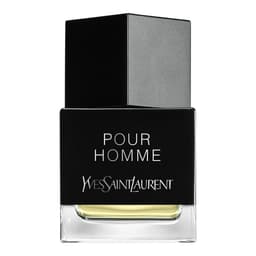
Pour Homme by Yves Saint Laurent, a taste for scandal. The story of the house Yves Saint Laurent is above all the story of a shy young man who, at just 21 years old, decided to create his own fashion house out of love for fashion.
Released in 1971, Pour Homme by Yves Saint Laurent is the perfume of revolt, on par with Rive Gauche, released the same year. The first masculine perfume from the house YSL, Pour Homme is provocative and shocking, just as the designer liked to be. Indeed, for the advertisement for Pour Homme, Yves Saint Laurent decided to pose nude. His slogan was then: This is my Eau de Toilette, now it can be yours…. Citrus and aromatic, the fragrance Pour Homme is the perfume of elegant men.
Pour Homme YSL, the first masculine perfume signed Raymond Chaillan
YSL decided to choose Raymond Chaillan to create its first masculine perfume. Born in Nice, Raymond Chaillan initially pursued studies in mathematics, before obtaining an engineering degree from ENSIA. His career in perfumery truly began in 1969 within the company Roure, where he worked for 10 years. He then joined the company Firmenich, and was named Director of Research in perfumery within the company J&E Sozio. In 1995, Raymond Chaillan also became President of the Société Française des Parfumeurs. Raymond Chaillan is behind major olfactory successes such as Anaïs Anaïs by Cacharel, Quartz by Molyneux and Boucheron pour Homme by Boucheron.
Pour Homme YSL, elegant and virile notes
Pour Homme opens with a multifaceted freshness, combining lavender, petitgrain, rosemary, verbena, bergamot and lemon, giving the whole composition a very masculine character. Petitgrain actually refers to the essential oil obtained from the leaves and twigs of trees of the citrus genus. Bitter orange petitgrain comes from the bitter orange or bitter orange tree, an evergreen tree of the Rutaceae family growing up to 5 m tall. Originally from China, petitgrain has been used for centuries in traditional medicine (for cardiac and digestive disorders). It gradually became acclimated to Mediterranean regions, and its cultivation is now found as far as Paraguay. In perfumery, petitgrain releases green, fresh, citrus tonalities, but also floral and bitter ones. Then, the heart of Pour Homme is thoroughly aromatic, combining clary sage, carnation and geranium. The benefits of clary sage have been known since antiquity.
Traces of it can be found in the writings of Greek physicians, who nicknamed it “Herba Sacra.” Originally from western Asia and southern Europe, clary sage can reach 1.50 m in height. While clary sage is still used for its medicinal properties, it is also used in cooking to enhance meats and sauces. In perfumery, clary sage is an ingredient more often used in masculine compositions. It offers herbaceous, aromatic, floral and camphoraceous tonalities. Finally, the base of Pour Homme is thoroughly virile thanks to the presence of oakmoss, vetiver, patchouli and white musks.