
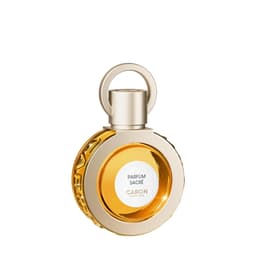
Parfum Sacré, the sacred origins of perfume. It was Ernest Daltroff who founded the house of Caron in 1902. With his brother Raoul, he bought a perfumery-haberdashery, La maison d'Émilia
Released in 1991, Parfum Sacré echoes the origins of perfume. Originally, perfume consisted of incense and resins that were burned and offered to the gods. It should be noted that the word perfume comes from the Latin per fume, meaning through smoke. Perfume would evolve along with the world, its peoples and its customs. Spiritual and mysterious, Parfum Sacré draws close to the origin of what was once called perfume. Parfum Sacré represents the quintessence of femininity.
Parfum Sacré, fragrant emotions signed by Jean-Pierre Béthouart
Caron chose as perfumer Jean-Pierre Béthouart. Born in Picardy, Jean-Pierre Béthouart first studied chemistry before being hired by Givaudan in 1981. In 1988, Jean-Pierre Béthouart left Givaudan to join Firmenich. There, he specialized in the creation of flavors, whether for perfumery or for the food industry. Jean-Pierre Béthouart created great perfumes, classic and timeless, such as Boucheron Femme and Boucheron Homme by Boucheron, Eau Ressourçante by Clarins, and Fleur de Cabotine by Grès.
The oriental and spicy notes of Parfum Sacré by Caron
Parfum Sacré takes on power and opulence from the very start with top notes that are anything but usual. Indeed, they combine black pepper, cinnamon, coriander and cardamom. Originating in Southeast Asia, coriander was first used for its medicinal properties, mainly digestive. The Romans used coriander because it had the power to preserve meat. In the Middle Ages, it was used to ward off lice. Also called Arabic parsley, coriander offers a powerful, strong taste and holds a prized place in Asian and Indian cuisine. In perfumery, coriander is used by steam-distilling its seeds, which are then ground into powder. Then, the heart of Parfum Sacré is highly floral thanks to the presence of rose, jasmine and mimosa, all enhanced by clove. The clove tree is a tropical tree. Its flower buds are shaped like nails, hence its name in French, clou de girofle. The earliest traces of clove are found in a book of Ayurvedic medicine. Clove developed in Mediterranean regions between the 4th and 7th centuries. Today, clove holds an important place as a spice and blends perfectly into many dishes and desserts. In perfumery, clove is used by steam-distilling the flower buds. Clove releases spicy, floral and sweet tonalities. Finally, the base of Parfum Sacré develops into a highly sensual sillage with the presence of myrrh, white musks, incense, sandalwood and benzoin. Its bottle is rectangular and understated. It is simply adorned with a golden label and reveals the golden nectar of its composition.