
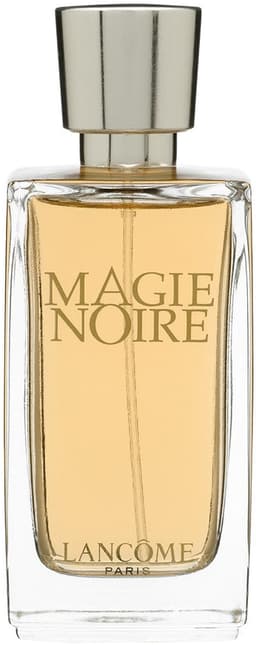
Lancôme launched Magie Noire in 1978; Gérard Goupy composed the formula. A dark oriental, at once green and animalic, it now opens, according to the house, on bergamot, blackcurrant bud and Bulgarian rose, before a heart of jasmine, narcissus and ylang-ylang and a base of amber, sandalwood and patchouli. Its slender yet massive bottle enhances a gold-colored juice.
The house describes a sparkling opening of bergamot and blackcurrant, a rich floral heart of jasmine, narcissus and roses, wrapped in sandalwood and amber to leave a powerful, bewitching trail.
In the list of notes it publishes, Bulgarian rose and blackcurrant bud open the fragrance, jasmine and ylang-ylang form its heart, and amber, sandalwood and patchouli its base. It sees in it a bewitching mystery within a bouquet of white flowers.
It also speaks of a figure-eight construction: the fragrance unfolds fully, turns back in a to-and-fro movement and ultimately returns to its original expression.
What the reviewers say
Victoria Frolova of Bois de Jasmin first notices the resinous, bitter, green notes of blackcurrant bud and galbanum, embellished with glints of citrus, aldehydes and lily of the valley. She describes the fusion of an oriental accord, amber, tobacco and musk, with a chypre, moss, patchouli and rose.
The base turns animalic: castoreum, musk and civet, tempered by the heady sweetness of tuberose and ylang-ylang on one side and by the austere dryness of woods on the other. The green facet persists and keeps it from sinking into the languor of an ordinary oriental.
Elena Vosnaki perceives an ammoniac, feline opening, a fruity purple veil over very dark roses, sharp greens, galbanum and hyacinth, heightened by castoreum. The softer, musky, incense-laden base keeps a hint of caramel.
What stays out
The 2009 and 2011 reviews also mention hyacinth, galbanum, raspberry, honey, tuberose, lily of the valley, oakmoss, labdanum, castoreum and civet; an older house text cited myrrh and incense. The current list includes none of them.
Similar perfumes
Similar notes and family, from other houses.
- TabuDana
- CK One Shock for HerCalvin Klein
- Le Classique Airlines Edition 2020Jean Paul Gaultier
- Matière NoireLouis Vuitton
- Coco Eau de ToiletteChanel
- White DiamondsElizabeth Taylor
- Supreme BouquetYves Saint Laurent
- My Burberry BlackBurberry