
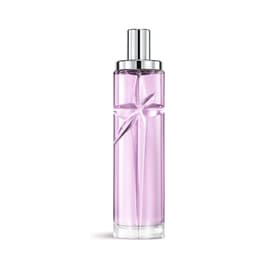
Berry Licorice (2026) is the third of Mugler's Starlicious eaux de toilette, and the only one of the three to oppose bitterness to its sugar. Strawberry and raspberry open on a red candy register, freesia lightens the passage, licorice closes on an anise note that cuts through the confectionery. A gourmand fruity fragrance of simple design, whose interest lies in this contrast rather than in an accumulation of sweet materials.
What the label calls rose ketones does, for the berry accord, more work than the strawberry and raspberry combined. These molecules were isolated from rose essence some fifty years ago, and their strength is such that they are dosed in traces: at that level they no longer smell of rose at all, but of red fruit jam, prune, blond tobacco. It is the standard tool for giving volume to a red fruit, and it is what allows such a light eau to project such a distinct accord.
Freesia, for its part, belongs to those flowers from which nothing can be extracted. Neither distillation nor extraction yields anything usable, and what is smelled under this name comes entirely from the laboratory. The label lists benzyl salicylate, a material used precisely to suggest flower without giving it strong character. The choice holds up: between a very sweet fruit and a bitter base, a bridge is needed, and a flower without strong identity is what makes the joint without taking sides.
One material appears on the label without appearing in the pyramid: patchouli oil. Mugler does not mention it anywhere for this juice, whereas the pistachio sibling does announce it. Its presence is not surprising, patchouli being the classic anchor under a gourmand, but it is a reminder that a commercial pyramid names four materials where a formula counts several dozen. Two ways of describing the same liquid, neither of which lies.
The bitterness, moreover, does not come from licorice alone. The list also carries an essence of bitter orange zest, and beta-caryophyllene, peppery and woody. The contrast is thus written into several points of the formula rather than concentrated on a single material, which explains why it remains legible under such an emphatic berry accord.