
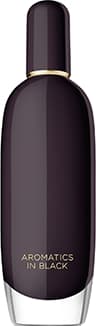
Aromatics in Black, mystery at its peak. The Clinique company was founded in 1968 in the United States, driven by the Estée Lauder group. From the very beginning, Clinique set out to be different with women, deciding to take care of their skin and to bring them real professionalism.
Released in 2015, Aromatics in Black follows the success of Aromatics Elixir, launched in 1972. Alluring and enigmatic, the Aromatics in Black fragrance is defined as oriental chypre. After Aromatics in White, released in 2014, Clinique wanted to offer a new take on its fragrance in the color black. The Aromatics in Black woman is not only intriguing and mysterious, but above all, irresistibly attractive. Thanks to its fragrance that is both oriental and floral, Aromatics in Black leaves no one indifferent.
Aromatics in Black, the Clinique Aromatics saga
It all began in 1972. At that time, Clinique wanted to launch its first fragrance. It should be noted that all Clinique products undergo allergy testing and are developed with the help of dermatologists. The launch of Aromatics Elixir therefore ran counter to this policy. Very different from the sanitized image the Clinique brand had at the time, Aromatics Elixir stood out as a fragrance with strong character. With its unique character, Aromatics Elixir proved to be timeless, as it still ranks among the 10 best-selling fragrances in the world. In 2014, Clinique released its first flanker, Aromatics in White, an aromachology fragrance through which the chypre family made a striking comeback. Aromatics in White is an olfactory inspiration full of promise. Its fragrance unfolds an extremely seductive sillage. Designed for both the body and the mind, Aromatics in White wraps the skin in a sensual velvet touch. In 2015, Clinique returned with a new, distinctly enigmatic color: black.
Aromatics in Black, bold fragrant notes
Aromatics in Black opens on fruity, dense notes, namely bergamot, pink grapefruit and plum leaves. The origin of the plum tree is uncertain, but it is known that in Egypt, dried plums were placed in the tombs of the pyramids. The plum tree is one of the least demanding fruit trees. It grows in every region and withstands cold down to -15°. Plums are more or less spherical and elongated, covered with a fine waxy film called bloom. In perfumery, plum leaves give off green, bitter, almond-like and slightly fruity tonalities. Then, the heart of Aromatics in Black takes on an immense femininity thanks to the presence of jasmine, osmanthus and neroli, giving the composition an extraordinary luminosity. Also known as the fragrant olive, osmanthus is a shrub native to Asia. Its foliage is evergreen, and its scent is very pronounced and highly floral. In Asia, osmanthus flowers have been cultivated for more than 2,000 years, solely for their scent. In perfumery, an osmanthus absolute is obtained through ethanol extraction of the concrete, which is itself obtained through extraction with volatile solvents. Osmanthus offers scents that are both floral and fruity, close to that of apricot. Finally, the base of Aromatics in Black is voluptuous and sensual, combining myrrh, vetiver and tonka bean. The bottle follows the design codes of its predecessor. Still elegant and elongated, it now wears a black color for the occasion, making it all the more enigmatic…