
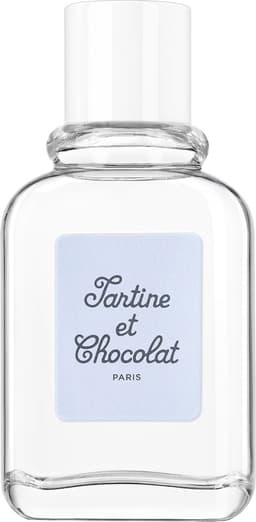
The perfume for children Tartine et Chocolat Ptisenbon is a fragrance from the house Tartine et Chocolat. The latter is devoted exclusively to the world of childhood while favoring a deep elegance. Thus, Tartine et Chocolat creations are renowned for being timeless and extend from childcare accessories to the wardrobe of the youngest ones, as well as furniture and perfumery. Ptisenbon immerses the wearer in this refined and creative world, marked by quality and simplicity.
Ptisenbon was born in 1987 and symbolizes the entire world of babies and children, who finally have their own fragrance! Ptisenbon is delicate and soft like a mother's caress. Ptisenbon is an Eau de Toilette for children and it offers maximum tenderness. Alcohol-free for babies, the Ptisenbon range is lightly alcoholic for those over 3 years old. Discreet and airy, the Ptisenbon Eau de Toilette can thus accompany children from 0 to 6 years old.
Ptisenbon, the children's fragrance market
Nowadays, fragrance has no age and fashion houses almost all have their own fragrances for children. While the children's fragrance market currently weighs 11 million euros, this has not always been the case. In 1970, the house Dior was the first to venture into this niche with Baby Dior. Nevertheless, Baby Dior never achieved the expected success and fell into obscurity. 16 years later, Annick Goutal attempted a new approach with L'Eau de Bonpoint. Success was then mixed, and it would take until 1987 for the house Tartine et Chocolat to present Ptisenbon. Created by Givenchy, Ptisenbon is the reference when it comes to children's fragrances.
The floral and airy scent of Ptisenbon by Tartine et Chocolat
Delicate and pure, Ptisenbon opens on the freshness of lemon and bergamot. An ancient citrus fruit, bergamot is nowadays mainly grown in Italy in the province of Reggio Calabria. Bergamot has the spherical shape of an orange and the color of a lemon. Bergamot is not eaten; it is used for its olfactory properties. Back when fragrances were made only of natural ingredients, bergamot served as a fixative. In perfumery, bergamot essence is obtained by cold expression of the fruit's peel. It releases fresh, floral, lavender-like and orangey tonalities. Then, the heart of Ptisenbon takes on soft floral touches thanks to the presence of honeysuckle, lily of the valley and jasmine. The quintessential emblem of May Day, lily of the valley fascinates with its small white bells. Also called lily of the valley, it traces its origins to Japan. Lily of the valley multiplies through its rhizomes called claws. In mythology, it is said that the god Apollo created lily of the valley to offer his nine barefoot nymphs a soft and fragrant carpet on which they could walk. It was King Charles IX who offered a sprig of lily of the valley on a May Day to his subjects, wishing them happiness, thus establishing the tradition known today. In perfumery, lily of the valley releases tonalities that are both soft and musky. Then, the base of Ptisenbon is delicately sensual as it combines white musks with cedarwood. In white and blue, the bottle offers one final touch of delicacy.