
 Oriental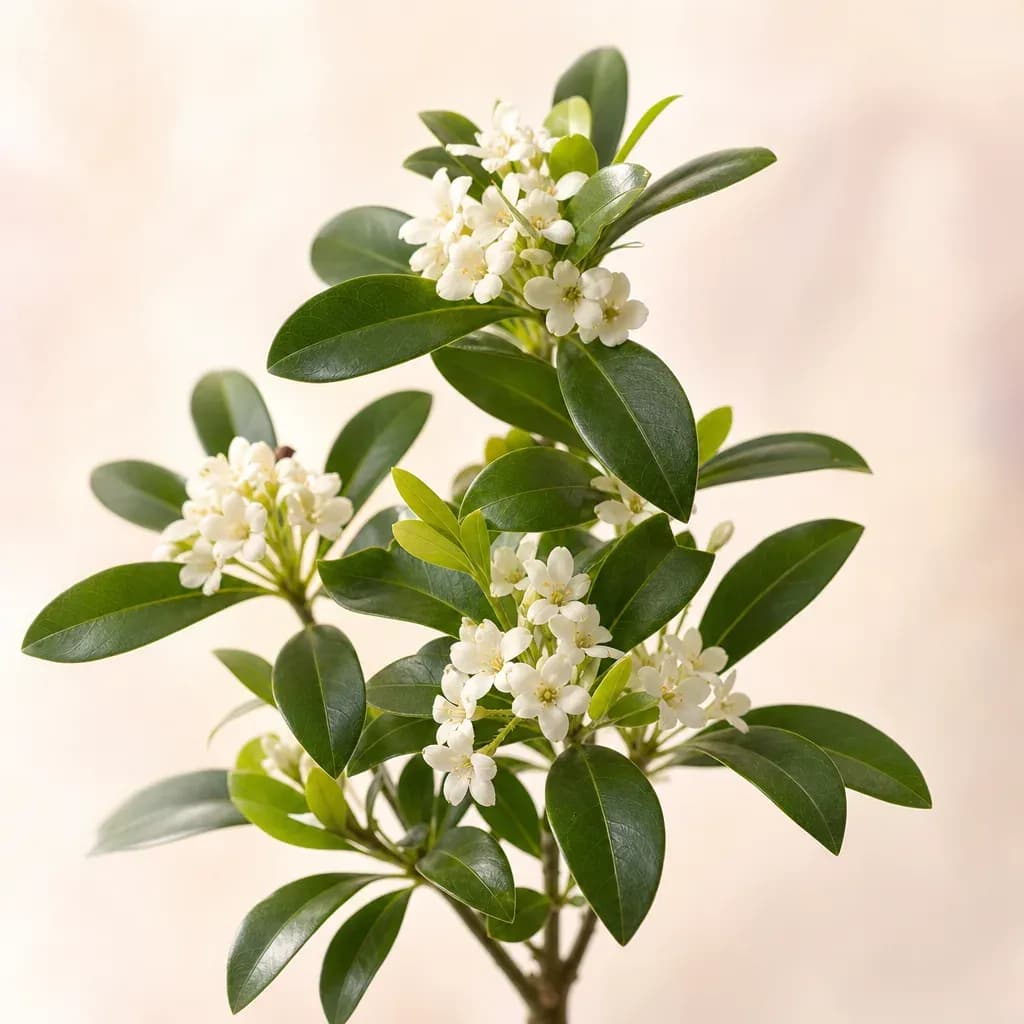
Pittosporum
Pittosporum, a decorative shrub of Asian origin. Perfumery is an art that uses scents to carry the imagination to every corner of the globe. Moreover, perfumers do not hesitate to travel the entire planet in search of new raw materials, each one more exotic and surprising than the last. Pittosporum, in this case, comes from Asian countries. Very common in China and Japan, it is an evergreen shrub, highly decorative and ornamental. Its rounded habit spreads across 2 to 5 meters. Its dark green leaves are both glossy and leathery, bearing clusters of flowers at their tips. Pittosporum does not care for cold weather and much prefers sunny positions sheltered from wind. It therefore evokes summer and blends easily into summery compositions.
The sun-kissed flowers of Pittosporum
Pittosporum has more than 200 different varieties. Two of them stand out for their flowers. The first is Japanese Pittosporum. Bearing clusters of small, star-shaped white flowers, Japanese Pittosporum blooms in May and June. Its cream-colored flowers form small clusters at the tips of its branches. Their scent is very close to that of orange blossom. In other words, it is floral, waxy, powdery, green and slightly sweet. The other flowering variety of Pittosporum is called “small-leaved Pittosporum.” Smaller in size, it is known for its black-barked branches and dense foliage. From March to April, it is also covered with numerous very dark purple tubular flowers. These are more gourmand and reveal a delicate honey scent. They therefore plunge the fragrances containing them into a very fashionable sweetness, without ever becoming too heavy. Pittosporum thus manages to be gourmand while preserving a very floral and airy lightness.
Pittosporum, a scent reproduced in the laboratory
Unlike many flowers, the scent of Pittosporum cannot be directly extracted in nature. If it can be incorporated into fragrances today, it is above all thanks to scientific progress. Pittosporum is what is known as a mute flower, whose scent must be entirely reconstructed using synthetic molecules. Its use is, therefore, fairly recent in the history of perfumery. The scent thus obtained nevertheless remains close to that of the shrub’s original floral note. Its authenticity is surprising… Enough to carry one to Asian lands with a single breath! Every house is fond of it, and Pittosporum can boast of having already been used by the famous houses Armani, Hugo Boss, Dolce & Gabbana and Versace. It remains, however, more commonly used in feminine compositions.
Perfumes with the Pittosporum note
Oriental Floral
 Chypre