
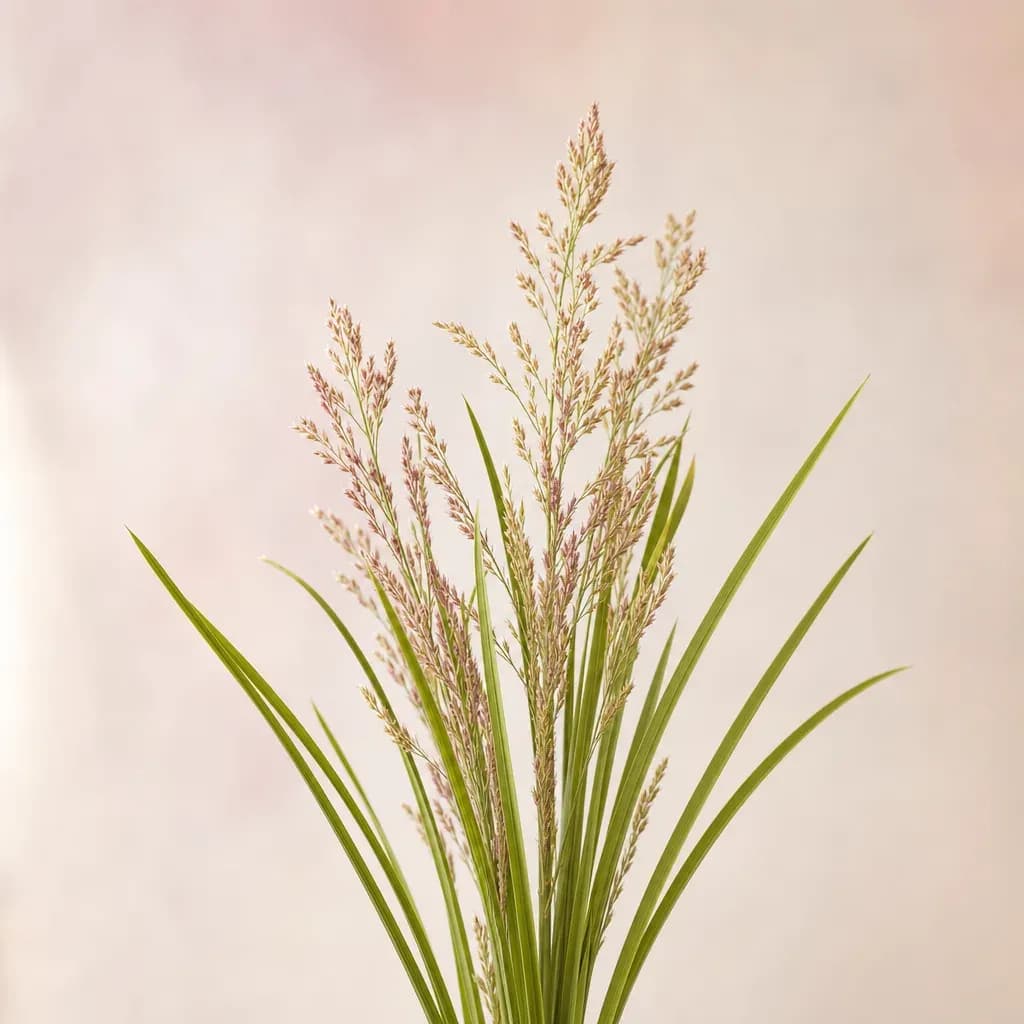
Palmarosa
Palmarosa: the “Indian geranium” for floral and fresh perfumes Well known across Asia, particularly in India and Vietnam, palmarosa and its medicinal benefits remain little known elsewhere. Yet as early as 1933, Guerlain used this beautiful grass, a fine connoisseur of its powerful olfactory potential rich in floral notes reminiscent of rose or geranium.
After this lovely bottle, it took until the new millennium to once again enjoy the original palmarosa note in our favorite fragrances.
The origins of palmarosa
Palmarosa is a grass that can reach up to 3 meters thanks to its long, highly fragrant tapered leaves and its scented red flowers resembling the geranium flower. It is native to South Asia, where it has been well known for a very long time.
Indeed, palmarosa, from which an essential oil is extracted, has multiple properties that Ayurvedic medicine has used for centuries, particularly for dermatological problems such as eczema or fungal conditions.
The pretty cousin of citronella is of course also a prized raw material in fine perfumery thanks to its fresh, delicate scent, particularly reminiscent of rose or geranium, hence its nickname, the “Indian geranium.” Guerlain was the first to use palmarosa as a fragrant note in its fragrance Vol de Nuit in 1933.
Vol de Nuit is considered one of Guerlain’s most complex perfumes, as its representation in fragrance of Saint-Exupéry’s famous novel aims to be an olfactory journey. The very powerful, gripping top notes, like a takeoff, lead to base notes including palmarosa, described as “a fireworks display” by the creator Annick Goutal, before concluding in an oriental sillage, powerful and intoxicating. A beautiful journey, then, that would bring success to Guerlain. However, it would take a very long time before once again having the pleasure of experiencing the palmarosa note...
The scents of palmarosa in our perfumes
Palmarosa, an exotic fragrant sweetness from Asia, releases its scent in rare fragrances that place it in top notes or heart notes depending on the desired accord of the composition.
Thanks to Léonard Léonard released in 2001, we finally have the pleasure of rediscovering the palmarosa note decades after Guerlain’s lovely Vol de Nuit. The fragrance opens on fruity and floral top notes where palmarosa blends with freesia, violet leaf and blackcurrant for olfactory flights of flowers and sugar.
Géranium Bourbon by Miller Harris also uses the palmarosa note as a top note to open its woody floral fragrance on green, fruity and spicy notes, aiming to recreate the exotic sensations of the colors of Cashmere.
As for L’Eau Bleue by Issey Miyake, this lovely aromatic fragrance offers the palmarosa note as a heart note to release its floral scents of rose and spice while offering a fresh, woody, even amber aromatic whole.
Palmarosa is therefore a very distinctive fragrant note that, depending on the fragrance pairing, can highlight floral facets, aromatic facets or exotic and oriental facets. It would seem that, despite its rarity, these multiple facets it has to offer can be the hallmark of an original and delicate juice.
Identity card
- Latin name : Cymbopogon Martinii
- Origin : Herbe
- Country : IN
- Part used : Herbes
- Type : Naturel