
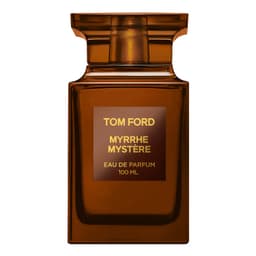
Myrrhe Mystère entered the Private Blend catalog in September 2023. Tom Ford builds an Eau de Parfum here on two myrrh extracts, an essence and a resinoid, held by an Australian sandalwood and a vanilla accord, with absinthe and a black leather darkening the edges. Critics praised the restraint and disputed the price.
A list, not a pyramid
Tom Ford publishes seven entries and no hierarchy: myrrh essence and Orpur myrrh resinoid, United States absinthe, Orpur Australian sandalwood album, Orpur jasmine absolute, Ultra-Vanille accord, black leather accord.
Three raw materials carry the bulk of the statement: myrrh, sandalwood and vanilla. Absinthe, jasmine and leather are named without the house assigning them a rank, and the fragrance therefore reads in depth rather than in stages.
The two myrrhs
The essence gives the fresh, bitter facet of the resin, almost medicinal; the resinoid gives the thick, sweet, slightly dusty facet. Together, they occupy the fragrance from beginning to end instead of taking turns.
This doubling explains what the house emphasizes: a sustained density rather than a progression. Myrrh is not a passage of the fragrance, it is its backdrop.
Absinthe, jasmine, leather
Absinthe pushes a green, aromatic bitterness that cuts the sweetness of the balsam. Jasmine absolute, in small doses, adds a bit of floral flesh to a material that has none. Neither one seeks to be heard.
Leather arrives as an accord and not as a raw material: a black leather, dark and smoky, that extends the resin toward the burnt side rather than the sweet side.
Two accords, not two raw materials
Ultra-Vanille and black leather are constructions, and the house says so in its own terms. These are not a bean and a hide, but two assemblages made to render the idea of each.
The detail matters to anyone who reads a list of notes as an inventory of raw materials. Here, part of the statement belongs to the brand's vocabulary, the other only to the material.