
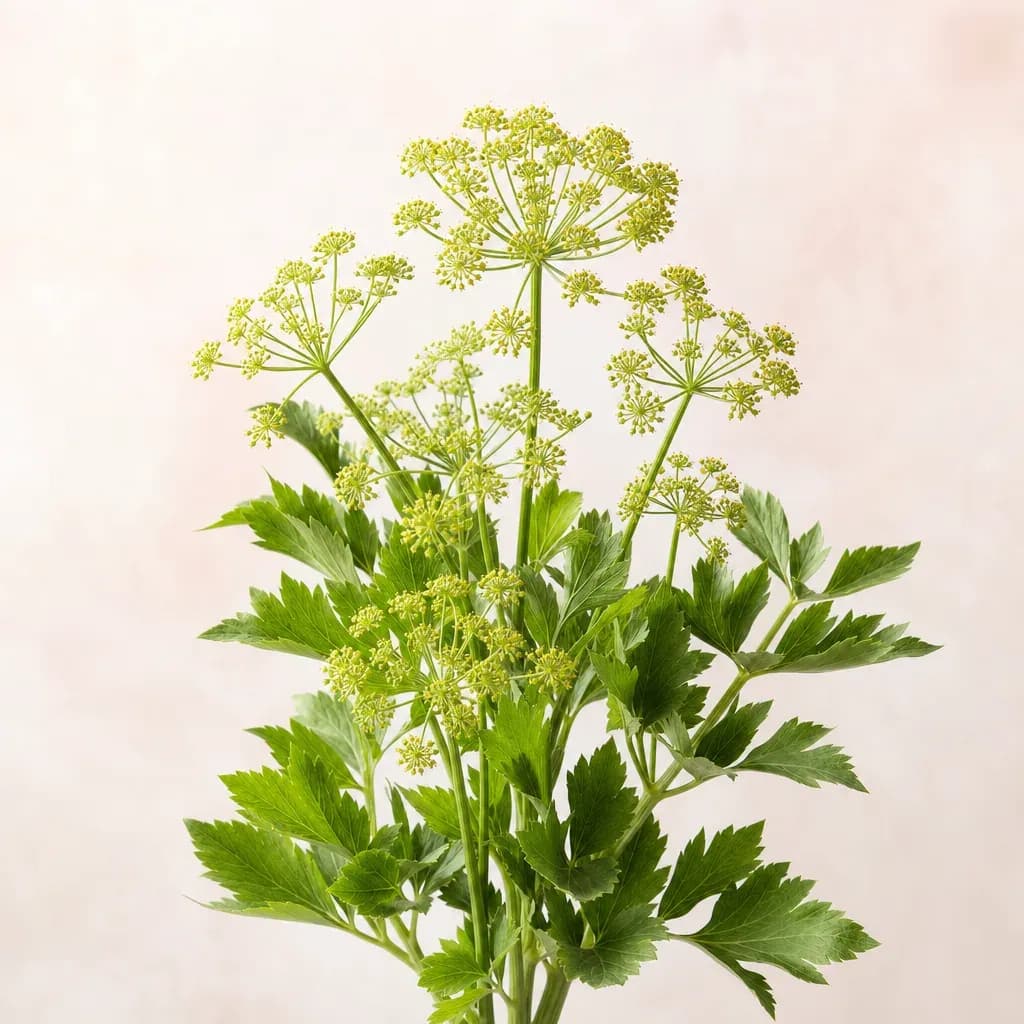
Lovage
Lovage: celery's mountain cousin in perfumery. Lovage is an aromatic plant known in our European lands since the 9th century, when Charlemagne had it planted in the emperor's famous gardens. A pretty umbelliferous plant, it is believed to be native to Iran, yet it is on our Alpine or Pyrenean peaks that it now grows.
Lovage essential oil, besides its many medicinal properties, makes it possible to create pretty tangy notes as well as to form a famous perfumery molecule: coumarin.
Lovage, a multifaceted aromatic plant
Lovage, mainly used by Benedictine monks in the 9th century, was recognized in particular by Charlemagne for its many virtues.
In the Middle Ages, lovage was used both as a culinary aromatic condiment (still widely used in Moldavian or Bulgarian cuisine) and as a soothing remedy against ulcers, boils, or even kidney stone colic. More legendarily, lovage was also closely linked to magic and, like its cousin celery, it was part of the secret composition of famous love potions.
As soon as the making of essential oils was discovered, lovage took its place among phytotherapeutic remedies as well as among the natural raw materials used by perfumers. However, it remains rarely used as such, but while the note of lovage is barely known in perfumery, the molecule it can help produce through its active compounds is very well known indeed: coumarin.
The use of the lovage note in perfumery
The lovage note used as such in perfumery is explicitly named in only one single fragrance: Sel de Vétiver by The Different Company. Released in 2006, this original spicy woody fragrance offers lovage notes in the base notes paired with iris and vetiver. Incidentally, the term Sel de Vétiver might remind us that lovage is the raw material used to make celery salt, as well as, less well known, the famous Maggi stock cubes found in our kitchens.
It would seem that lovage suffers from a total lack of recognition of its fragrant powers, when in fact it is, like other aromatic plants (true lavender, Chinese cinnamon…), also widely used to create a famous perfumery note: coumarin. Coumarin, a raw material found in many fougère and oriental fragrances, is a synthetic molecule that relies on active compounds present in lovage in particular in order to exist.
Thus, if we do not limit ourselves to the exact naming of lovage and to the possible production of the coumarin note through it, many fragrances could carry the lovage note hidden under the name coumarin. Let us hope that this injustice done to celery's cousin will be redressed so that the tangy, fresh facets of this rather lovely lovage note can finally be enjoyed.
Identity card
- Latin name : Levisticum officinalis
- Origin : Plante
- Country : FR
- Part used : Racines
- Type : Naturel