
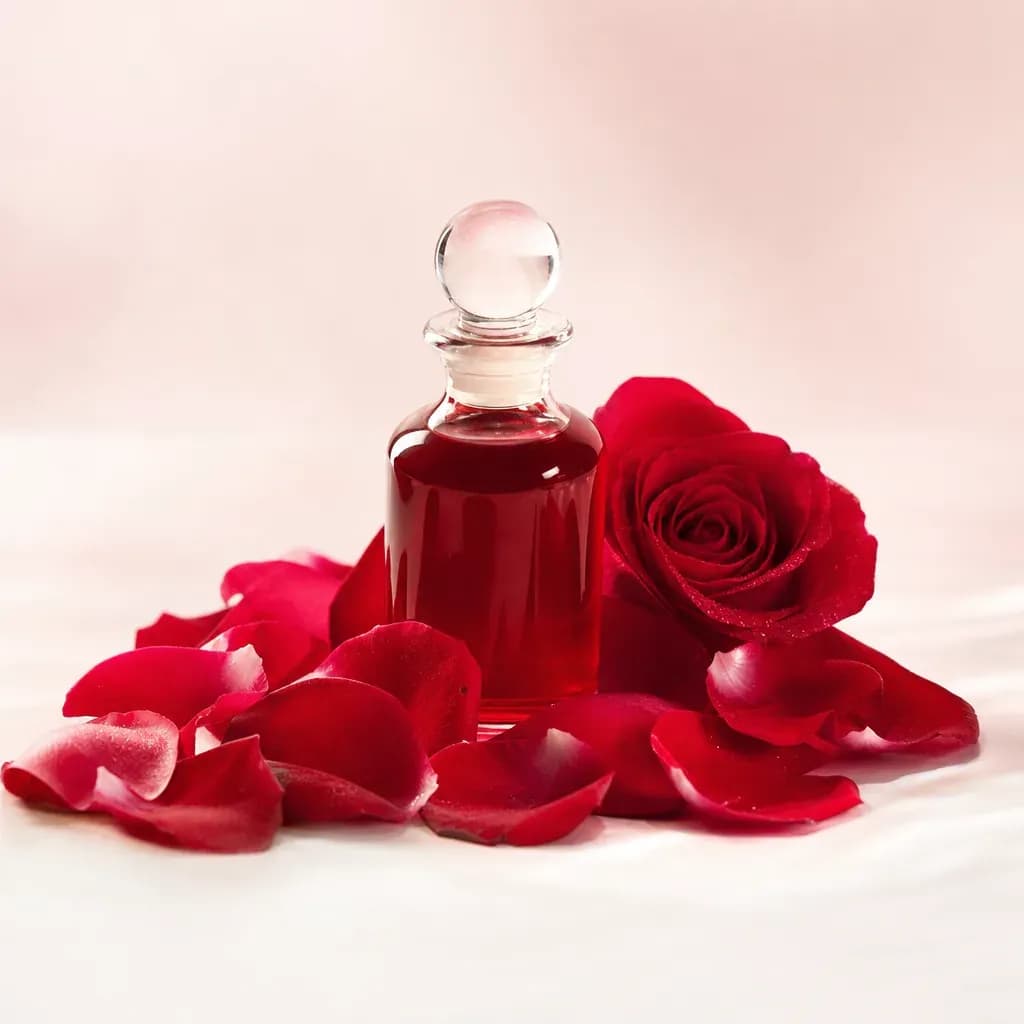
Damascone
Many olfactory formulas combine natural ingredients and synthetic compounds. Indeed, perfumery does not result solely from the creativity of perfumers. It also requires extensive knowledge in chemistry. Furthermore, many natural ingredients today cannot be extracted directly through conventional distillation or extraction techniques. This is why they are either reproduced by combining various natural products or entirely recreated in synthetic form. As such, damascone is among the complex ingredients used in our fragrances. It is a compound created entirely from scratch by the expert hands of perfumer-chemists.
The damascone molecule
Damascone is a chemical compound related to an essential oil. It first appeared in 1970, belonging to a family of molecules combining a fruity facet and a floral facet. It is used mainly in fragrance creation and is a synthetic product belonging to the ketone family, a category that also includes damascenone and ionones. Ketones are obtained through the controlled oxidation of a secondary alcohol. This requires a strong oxidizing agent but poses no subsequent risk to the skin. Damascone is a synthetic product whose main aroma is generally rose. However, there are different types with very distinctive sillages. Indeed, it is a molecule present in rose and contributes 70% of its scent. Similarly, damascone is also present in certain wines. Beyond its very feminine scent, damascone is also recognized for its therapeutic effects. In particular, it has the ability to protect the skin from sunburn by activating the sebaceous glands.
Damascone in our perfumes
Most often, damascone is present in fresh feminine perfumes. It is mainly paired with fruity tonalities such as apricot, pineapple or banana. Similarly, it blends wonderfully with blackcurrant bud. Damascone is found in all types of perfumes such as Lagarfeld Femme by Karl Lagarfeld, which is citrus, Aquaman by Rochas, which is rather woody, or Acteur by Azzaro, known for its chypre scent. As an example, note that the perfume Paris by Yves Saint-Laurent from 1983 contains beta-damascone, a molecule with a concise character and derived mainly from Bulgarian rose essential oil. Similarly, this same type of damascone is also present in Les Jardins de Bagatelle by Guerlain, also created in 1983. However, it should be noted that this is a complex ingredient, most often reserved for fine perfumery and luxury creative houses.
Identity card
- Latin name : Firmenich
- Origin : Identique Nature
- Type : Molécule