
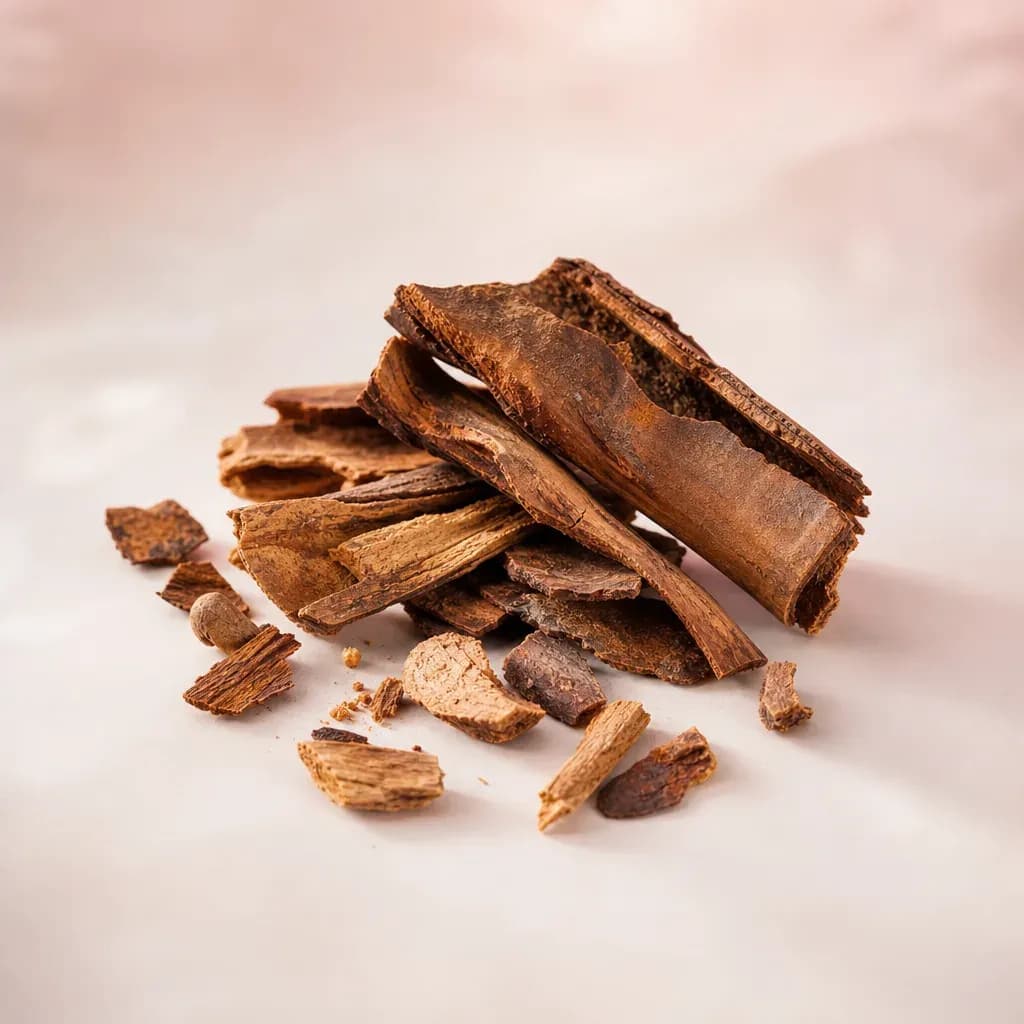
Cascarilla
Cascarilla: the essence of croton eluteria in perfumery. Cascarilla, or eluteria cotton, its best-known variety, originates from the Caribbean but grows in many tropical countries. Mainly known as a medicinal plant, cascarilla produces, through its essence, a woody, peppery, sweet and aromatic scent.
Although the cascarilla note has become rare, it nonetheless appears in beautiful perfumes that use this original note as the signature of their oriental or chypre fragrances, as with Lancôme's olfactory UFO Magie Noire...
Cascarilla, or croton eluteria, a tropical shrub with magical scents
Cascarilla is a small shrub covered in a reddish-brown bark, native to the Caribbean and the Bahamas. Although little known despite its many properties, cascarilla is widespread in numerous South American countries such as Mexico, Colombia or Panama.
While the shrub produces small flowers, it is its distinctive orange bark that is used to produce an essence or essential oil from this tropical plant. Cascarilla essence is widely used in herbal medicine for its digestive, expectorant and respiratory benefits.
Cascarilla essence should nonetheless be handled with caution, as it can cause discomfort or dizziness... Yet dizziness hardly deterred Lancôme's perfumers, who used it notably to create a disturbing and original perfume, Magie Noire.
The cascarilla note to enchant our fragrances
Like the sweet promise of an enchanting note, cascarilla has settled into some quite lovely fragrances to exhale its peppery, woody scents! There is, however, no point trying to classify it within a single olfactory family, for cascarilla is simply unclassifiable, as are many of the fragrances in which it appears!
Magie Noire by Lancôme, released in 1978, is typically one of those perfumes both unclassifiable and utterly surprising, exhaling, certainly for the very first time in broad daylight, the cascarilla note as a base note. The magic works in this composition, at once oriental and floral, fruity with blackcurrant notes and spicy with its bergamot, tender with its armfuls of jasmine and rose, as well as wild with its animalic notes paired with cascarilla in the base.
Later, Maître Parfumeur et Gantier revived the use of this lovely cascarilla essence with Rose Opulente. This floral, green perfume, released in 1989, offers rosy aldehydic top notes that open onto a heart of jasmine and cascarilla, blooming within a sillage of animalic notes. Here, the rose is thus oriental and delicately peppery thanks to cascarilla...
Finally, in 2005, Feuille de Tabac by Miller Harris offers the cascarilla note within a refreshing, aromatic mixed woody chypre. The cascarilla and chili pepper top notes provide an opening as bold as it is spicy, leading into aromatic and delicately woody heart notes. This fragrance's deep sillage blends tobacco, patchouli and tonka bean for a striking cocktail of scents recalling the atmosphere and emotions of a small Parisian café...
It would therefore seem that cascarilla, or croton eluteria, is that touch of woody originality that spices up the original fragrances of creators who do not hesitate to use novel, or nearly novel, raw materials to offer unique fragrances that feel almost timeless.
Identity card
- Latin name : Croton Eluteria
- Origin : Arbre
- Country : VE
- Part used : Écorces
- Type : Naturel