
Byredo
Oboro
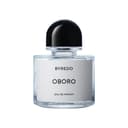
Oboro is a unisex Eau de Parfum by Byredo, composed by Jérôme Epinette and sold in Japan only since July 16, 2026. Its name borrows a Japanese word for a misty state with blurred contours. Its pyramid brings together bergamot, black pepper and ginger at the top, violet leaf, peony and mineral accord at the heart, and salty amber, incense and vetiver in the base.
Share
Where to buy
My collection
Byredo is reserving Oboro, an Eau de Parfum, for the Japanese market alone. The Swedish house puts it on sale on July 16, 2026, in some of its Japanese stores and online, in 50 ml at 32,120 yen and in 100 ml at 46,090 yen.
The Name of a Misty State
In Japanese, oboro describes a state in which outlines blur and memory and emotion melt gently into one another. Byredo makes it the theme of the fragrance: memories that have lost their outlines, emotions that have not yet become words.
The house says it draws on fleeting impressions and on the emotion left by things one never quite grasps. It describes a soft yet memorable fragrance with a quiet radiance, familiar and elusive, that invites one to feel rather than to look for answers.
Jérôme Epinette
The formula is signed by Jérôme Epinette, whom WWD Japan presents as Byredo’s representative perfumer. The house already owes him, among others, Gypsy Water and Bal d’Afrique; Oboro joins his creations for the brand founded in Stockholm.
Olfactory pyramid
- Top notesThe first minutes
- Heart notesThe heart of the perfume
- Base notesWhat lingers
Share your impressions
An error or a gap on this perfume page? Report it
Create an account to keep your votes and find your notebook.
The advertising
The Poet Gōzō Yoshimasu
The poet and artist Gōzō Yoshimasu, filmed by Umi Ishihara amid handwritten texts, blurred flowers and superimposed images.
For the launch, Byredo turns to Gōzō Yoshimasu, a major Japanese poet and artist, known for work that blends poetry, performance and visual research. Filmmaker Umi Ishihara directs the campaign film, which is accompanied by a series of photographic portraits.
The film shows Yoshimasu at work, in intimate portraits, amid handwritten texts, blurred flowers and superimposed images. It seeks to convey the uncertain memories and pre-verbal sensations that the house attaches to the name Oboro.
In store, an immersive experience takes up the poet’s world: misty visual settings, fragments of poems and public performances, in some of the house’s Japanese stores, to let people experience the world of Oboro beyond the fragrance alone.