
 Floral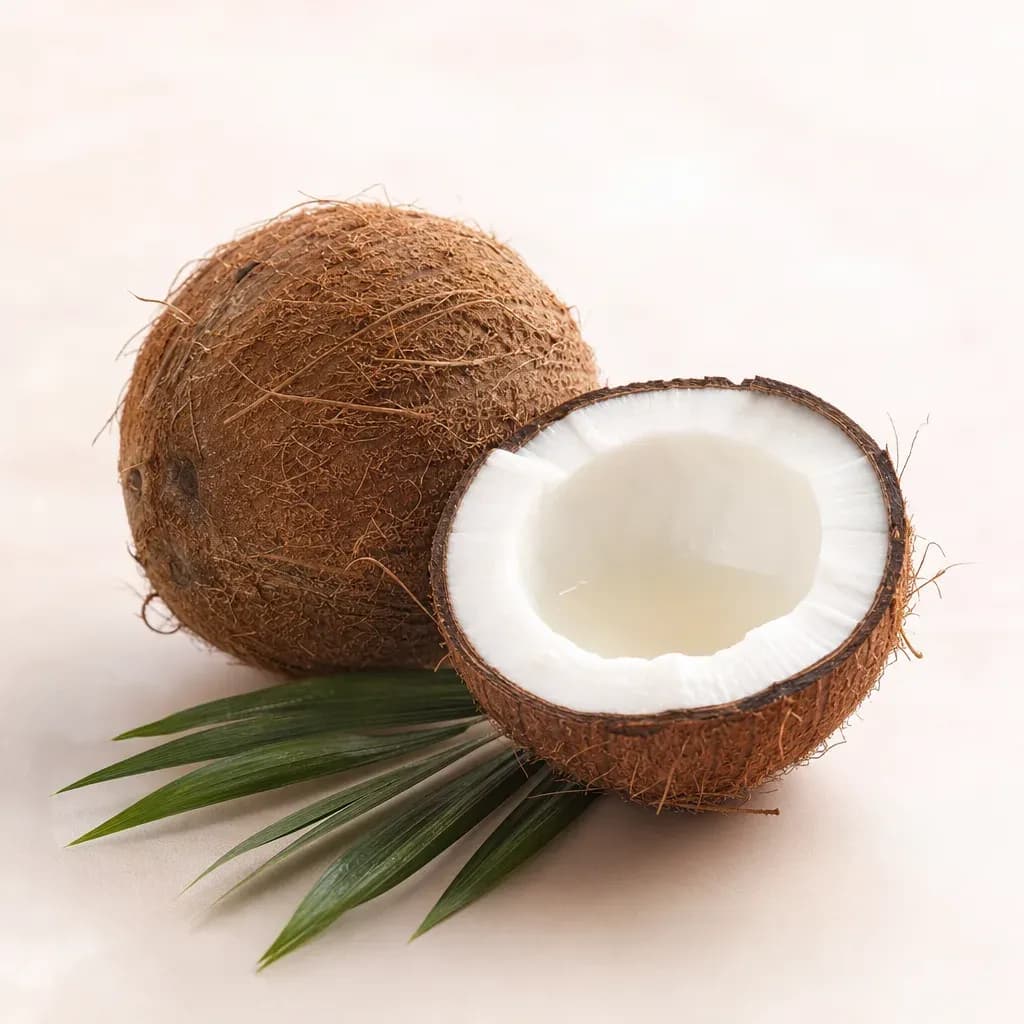
Coconut
Globalization and extensive trade with countries around the world today allow us to become familiar with numerous exotic products. As such, coconut is an ingredient that has made its way into store shelves and instantly transports the senses. It does not merely find its way into dishes but also features in many of our fragrances.
Coconut, a fruit from afar
Coconut is the fruit of the coconut palm. This tree belongs to the palm family, or Arecaceae. Its fruit can measure up to 30 cm in diameter. It is smooth and light green or orange in color when unripe. However, it is covered by a thick layer of brown fibrous husk as well as a solid shell protecting its whitish flesh, which is the edible part of the fruit. Germination of the coconut takes between 4 and 10 months, and the coconut palm bears its first fruit once it reaches 5 to 6 years of age. However, it only reaches maximum production once it is around fifteen years old. From then on, an adult coconut palm can bear between 50 and 500 coconuts. Its production then only begins to decline once it approaches around 50 years of age. Coconuts can be harvested in two ways: either by picking green fruit directly from the tree or by gathering ripe nuts that have fallen to the ground. It then takes a year before the coconut reaches full maturity. To open a coconut properly, it is customary to pierce it at its mouth, identified by three small dark marks at its base. The coconut then releases water, and it simply remains to split it open with a hammer or the back of a machete blade. Coconut is a particularly nourishing fruit. Moreover, it is rich in potassium, iron, magnesium, phosphorus, copper and zinc, giving it an exemplary nutritional value. Its juice can also be drunk as a refreshing beverage.
The exotic scent of coconut
Beyond its culinary uses, coconut is also widely used in perfumery. It most often appears in feminine compositions as well as in the creation of home fragrances. It is generally placed as a base note. It lends a gourmand, sun-kissed and milky tonality to the fragrances that contain it. Moreover, it considerably reinforces the exotic character of certain creations. To obtain its scent, perfumers choose to recreate it using other raw materials. In particular, they mainly use gamma-nonalactone, a lactone that occurs naturally in coconut. However, its flesh could also, if desired, be obtained through extraction, yielding an oil.
Today, the somewhat monoi-evocative scent that coconut can provide is present in many summer fragrances. As such, this fruit proudly appears in the CK One Summer 2014 edition by Calvin Klein or in Born in Paradise by Escada. Likewise, coconut is also a great favorite of the house Réminiscence.
Identity card
- Latin name : Cocos nucifera
- Origin : Artificielle
- Type : Reproduction
Perfumes with the Coconut note
Floral Floral
 Floral
 Woody
Woody
 Floral
 Floral
 Floral
 Fougère
 Floral
 Floral
 Woody
Woody