
 Oriental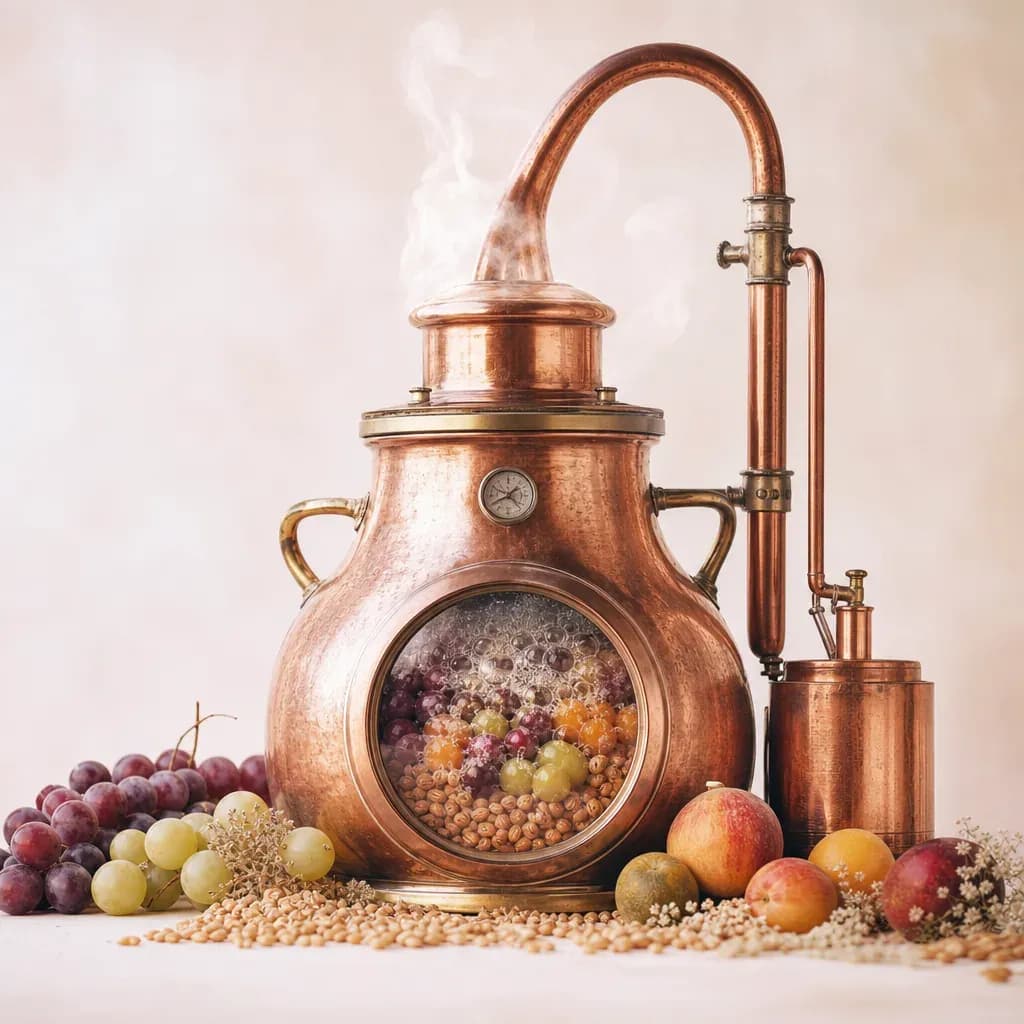
Eau de vie
Eau de vie, from the Latin Aqua Vitae, is a beverage obtained by distilling a fermented juice of plants, fruits, or grains. Eau de vie frequently refers to numerous alcoholic beverages such as armagnac, cognac, whisky or rum. Eau de vie was developed in the Middle Ages. The alcohol content of eau de vie made it an excellent antiseptic at the time. Eau de vie was used to treat children until the early twentieth century. It is distillation that allows the alcohol to be evaporated and then condensed in order to increase the proportion of alcohol in the final product.
The production of eau de vie
At 78.5°, alcohol evaporates, and this temperature is lower than the boiling point of water, which is 100°. At this temperature, the distillate still contains water. In order to obtain a complete distillation, several processes can be used, including the use of a third substance miscible when hot. In France, fruit eaux-de-vie are mainly produced. Eau de vie production takes place in two main stages, namely maceration and distillation. Fruits ferment naturally thanks to the sugar they contain. The fermented fruits are then immersed in eau de vie to macerate. Eau de vie should always be kept dry, away from light, and the bottle can then be kept for many years.
Eau de vie in perfumery
Although it may seem incredible, eaux-de-vie are used as fragrance notes. Among the most famous are rum, whisky and pure malt. Rum releases a highly prized aromatic complexity. Rum offers tonalities of vanilla, hazelnut, honey or cinnamon scents. Among the fragrances containing rum are Gourmand Coquin by Guerlain, Encounter by Calvin Klein and Ambre des Merveilles by Hermès. Whisky and pure malt offer rich odors, at once fruity, woody, floral or peaty. Whisky is found in fragrances such as Épices Marines by Hermès or Skin on Skin by L'Artisan Parfumeur. As for pure malt, it is mainly found in a star fragrance by Thierry Mugler, A*Men Pure Malt, a masculine composition with character.
While eau de vie was originally intended to treat children, mainly for anesthetic purposes, today eau de vie is intended for use in perfumery. Still little used in perfumery, eau de vie nonetheless comes in whisky, rum and pure malt forms, offering multiple and novel scents. Whether feminine or masculine, compositions containing eau de vie are strong and distinctive.
Perfumes with the Eau de vie note
Oriental